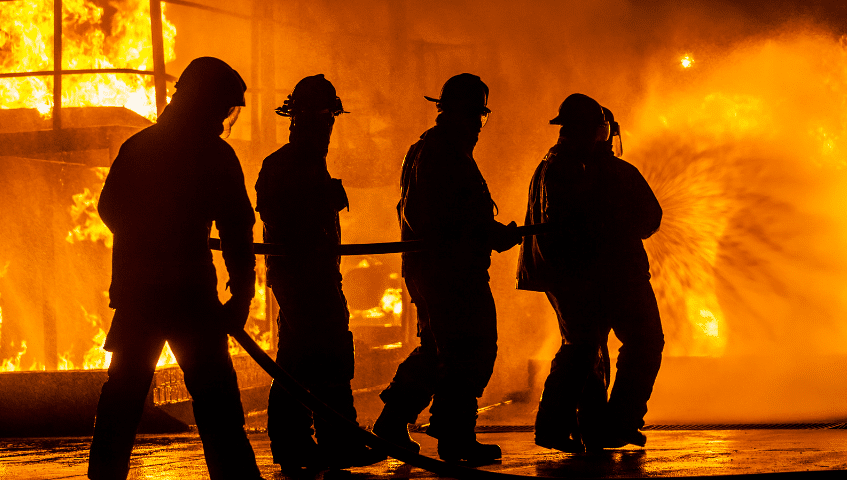
Who This Page is For
The Presumption Law, In Plain English
Firefighter Benefits in Washington State
Resources for Firefighters

Who This Page is For

The law treats first responder claims differently from ordinary workplace injuries, but not identically across roles. This page covers:

  • Firefighters, including supervisors, and public employee fire investigators
  • Law enforcement officers
  • EMTs and paramedics
  • Retired first responders whose condition appeared after they left the job
Two firefighters sorting equipment on their truck.

The Presumption Law, In Plain English

Most injured workers have to prove their condition came from the job. For firefighters, fire investigators and law enforcement officers, Washington law flips that burden for certain conditions. Under RCW 51.32.185, those conditions are presumed to be occupational diseases, and the employer has to prove otherwise.

Firefighters and fire investigators

  • Respiratory disease
  • Heart problems that appear within 72 hours of exposure to smoke, fumes or toxic substances, or within 24 hours of strenuous physical exertion on the job
  • Infectious diseases, including HIV and AIDS, hepatitis, meningococcal meningitis and tuberculosis
  • Cancer, after at least ten years of service
  • Post-traumatic stress disorder, after at least ten years of service

Law enforcement officers

  • Heart problems on the same timing described above
  • The same list of infectious diseases
  • Post-traumatic stress disorder, after at least ten years of service

What “presumed” does and does not mean

The presumption is rebuttable. It moves the starting point in your favor, but the employer or the Department can still contest the claim, and they often do. The kinds of evidence raised against these claims include tobacco use, weight and physical fitness, lifestyle, family history, and exposures away from work. A presumption is a strong position to argue from. It is not a decision in your favor.

firefighter presumptions

firefighter benefits

Firefighters and police officers are frequently diagnosed after retirement, particularly with cancer. The presumption does not end on your last shift. It extends three calendar months for every year you served, up to a maximum of 60 months after employment ends.

In practice: twenty years of service carries the presumption for the full five years. If you are outside that window, you can still file. You simply carry the burden of proof again, which makes the medical evidence and the exposure history that much more important.

Resources

The ten-year requirement is where most first responders are caught out, and it is the reason many never file at all.

If you have six years on the job and a PTSD diagnosis tied to what you have seen at work, you have not lost. What you have lost is the shortcut. The claim then turns on the medical evidence, the documented incidents, and how clearly the connection between the work and the condition is made. Those claims are won in Washington. They take more preparation.

Two practical things matter more than anything else here. First, get the diagnosis from a provider who understands occupational mental health claims and documents them properly. Second, do not wait, because the paper trail is easier to build while the incidents are recent.

Firefighter Hazards in the Workplace

Many Washington cities, counties and fire districts are self-insured, which means the employer pays claims directly rather than through the State Fund. Your benefits are the same on paper. What changes is who makes the decisions day to day, and who you are arguing with when a claim is denied or benefits are cut off.

Who Qualifies

Washington’s workers’ compensation system covers first responders the same way it covers any other worker, with one important addition: for some roles and some conditions, the law presumes your illness came from the job.

You are generally covered if you are:

  • A firefighter, including supervisors, employed full time and fully compensated by a fire department, or a firefighter at a private employer with more than fifty firefighters
  • A public employee fire investigator
  • A law enforcement officer
  • An EMT or paramedic, whether you work for a fire department, a private ambulance company or a hospital

Volunteers, part-time members and reserve officers are covered differently, and the presumption statute in particular is written around full-time, fully compensated service. If you are not sure where you stand, ask before you assume you are outside the system.

Coverage also does not stop when your service does. If you have retired and a condition has appeared since, you may still have a claim.

First Responder Benefits in Washington State

Washington has some of the country’s more protective laws for first responders. If your claim is allowed, your benefits can include medical treatment, time-loss compensation while you cannot work, vocational rehabilitation if you cannot return to your old job, a permanent partial disability award, a pension in the most serious cases, and survivor benefits for your family.

Two things set first responder claims apart from an ordinary L&I claim.

The presumption for certain conditions

Washington is one of the few states that recognizes the risks built into this work and shifts the burden of proof for specific conditions, rather than making you prove a cancer or a heart condition came from years of exposure on the job. That presumption is covered in full above.

Third-party claims

If someone other than your employer contributed to the harm, you may have a claim against them in addition to your L&I claim. For first responders, that often means conditions at the scene that made a response more dangerous than it should have been:

  • Improper asbestos remediation
  • Harmful or illegal substances that increased the toxicity of smoke
  • Faulty design or planning at the site
  • A negligent driver who caused the collision you responded to, or struck you at the scene

Third-party claims matter because they are not limited by the L&I benefit schedules. They reach an insurance policy or the responsible party directly, and they are often the difference between a modest recovery and a meaningful one. Most first responders never learn they had one.

Hazards of the Job

Washington law entitles you to medical care, time-loss benefits and vocational help when the job injures you. These are the injuries and exposures we see most often.

Overexertion and musculoskeletal injuries

Strains, back injuries and joint damage from lifting, carrying and forcing entry are the most common first responder injuries of all. For EMTs and paramedics, lifting patients is the single largest source.

Slips, trips and falls

Heavy gear shifts your balance and reduces your control on impact. Falls on stairs, wet ground, roofs and uneven scenes cause serious injuries in every first responder role.

Smoke, fumes and toxic exposure

Burning materials produce smoke that stays dangerous even with a respirator. Repeated exposure is the reason Washington presumes several cancers and respiratory diseases are occupational for firefighters.

Infectious disease

Responding to medical emergencies means contact with blood and bodily fluids. HIV and AIDS, hepatitis, meningococcal meningitis and tuberculosis are all named in the presumption statute.

Cardiac events

Heart problems that appear within 72 hours of exposure to smoke, fumes or toxic substances, or within 24 hours of strenuous exertion on duty, are presumed occupational.

Vehicle collisions and roadway incidents

Responding at speed, and working at the roadside with traffic passing, puts police officers and EMS crews at serious risk of collision and struck-by injuries.

Assault and violent encounters

Law enforcement officers and EMS crews are injured by the people they are trying to help or arrest. These injuries are compensable, and they frequently carry a psychological injury alongside the physical one.

Psychological injury

Repeated exposure to death, serious injury and violence causes real, diagnosable harm. PTSD is a compensable condition for first responders in Washington, and for firefighters and law enforcement officers with ten or more years of service it carries the presumption.


Resources for First Responders

Some of these are worth using long before there is any claim to talk about.

PIIERS (Personal Injury-Illness-Exposure Reporting System)

Sponsored by the Washington State Council of Fire Fighters, PIIERS is a confidential system for keeping your own record of exposures and injuries over a career. If you ever need to prove an exposure history years later, this is the record that does it.

Healthy In, Healthy Out

Also from the Washington State Council of Fire Fighters, aimed at reducing exposure to carcinogens and other hazards on the job.

Code 4 Northwest

A free, confidential crisis and referral line staffed by volunteers for active and retired Washington first responders and their families.

Safe Call Now

A confidential 24-hour crisis referral service for public safety employees, emergency services personnel and their families nationwide.

Firefighter Cancer Support Network

Support and guidance for firefighters and their families facing a cancer diagnosis, which remains one of the leading causes of death in the fire service.

Your union or guild representative

Your local, guild or association can often tell you how similar claims at your department have gone, and whether the department is self-insured.

How to File an L&I Claim in Washington State

Two things matter before a claim is even filed:

  1. Get medical help.
  2. Tell your employer.

You can file a claim three ways:

  • By phone at 877.561.3453
  • Online through L&I’s File Fast tool
  • At your doctor’s office, when you are treated

If your department or city is self-insured, you file with them rather than with L&I. Many Washington fire districts, cities and counties are self-insured, so check before you file.

To file, you will need:

  • Where the injury happened
  • Contact details for any witnesses
  • Your employer’s information
  • Your wage information
  • If you have already seen a doctor, their name and the hospital or clinic where you were treated

One point specific to this work: for exposure and psychological claims there is often no single incident to point to. Write down what happened and when, as close to the event as you can. Those notes carry real weight later.

Your L&I Claim May Be Worth More If You Also Have an Employment Claim

A significant number of Washington L&I claims sit alongside another legal claim, and most injured workers never find out. Beyond a third-party claim, your treatment at work after an injury can give rise to an employment claim of its own: retaliation for filing, a refusal to accommodate restrictions, or discipline that follows a protected complaint.

Emery | Reddy practices both employment law and workers’ compensation. That means we look at every part of your situation, not only the claim file, so you are not left with the smaller of two recoveries.

How Do I Know If I Have a Strong Claim?

Most first responders who call us are asking one of a few questions: my claim was denied, my benefits stopped, the IME doctor said I can go back, or nobody will tell me whether this condition counts. Any of those is worth a conversation.

Signs your claim needs attention:

  • Your claim was denied, or closed before you were ready
  • Time-loss benefits stopped while you were still unable to work
  • An independent medical examination reached a conclusion your own doctor disagrees with
  • You were told your condition is not work related, when it is on the presumption list
  • You have been diagnosed after leaving the job and were told you are too late
  • You are being pushed back to full duty before you are fit for it

Emery | Reddy Can Help with Your Washington L&I Claim

We have represented Washington first responders and their families, including recovering $500,000 in L&I survivor benefits for the family of a police officer whose death was connected to PTSD. We know this work, we know the statute, and we know how these claims are fought.

Talk to a Washington L&I attorney who handles first responder claims. Free case review, no fee unless we recover for you.

Common questions

Does the presumption mean my claim is automatically approved?

No. It means the condition is presumed work related and the employer must prove otherwise. Claims with the presumption are still denied, and those denials can be protested and appealed.

I have PTSD but fewer than ten years of service. Can I still file?

Yes. You file the same way; you just do not get the presumption, so the medical evidence and documentation carry the case.

I retired three years ago and was just diagnosed with cancer. Is it too late?

Probably not. The presumption extends three months per year of service, up to 60 months after you leave. Call before you assume you are out of time.

My department is self-insured. Is that worse?

Not necessarily, but it changes who you are dealing with. It is worth understanding that before your first protest.

How to File an L&I Claim in Washington State

In order to receive benefits from L&I there are two very important things that you must do right away, even before a claim is filed:

  • Get medical help.
  • Tell your employer.

If you are injured at work, you have three options to file a Washington state L&I claim:

Note that if you work with a self-insured employer, you must file your claim with them.

To file an L&I claim in Washington state, you must provide the following:

  • The location where the injury occurred
  • Contact information for any witnesses to the injury
  • Employer information
  • Wage information
  • If you have already seen a doctor:
    • Your doctor’s first and last name
    • The hospital or clinic where you received treatment

If you are eligible for time-loss, and no further information is needed, L&I or your self-insured employer will send the first benefit check within 7 days of receiving the report. If your doctor is one of the many healthcare providers that do not handle workers’ compensation claim cases, you can find an L&I-approved doctor on the L&I website. If your L&I claim is approved, L&I will cover the initial visit even if it wasn’t with one of their approved doctors.

L&I or your self-insured employer must receive your Report of Accident within 1 year of your injury date to file a claim. Occupational illness claims must be received within 2 years from the date that your doctor notifies you in writing that your injury is work-related.

HOW IT WORKS

Learn How Employment Law and L&I Claims Work Together

Free Case Review

Your Washington State L&I Claim Is Worth More If You Also Have an Employment Claim

A significant number of Washington state L&I claims often involve additional legal claims such as employment or third-party claims. Many people file their claims without seeking representation from an experienced Washington L&I attorney and thus never discover that, in addition to their Washington state L&I claim, they may be missing out on the ability to file an employment claim or a third-party claim. Pursuing additional legal action with the help of an experienced Seattle workers’ compensation and L&I attorney has the potential to significantly increase a claim’s overall compensation. At Emery | Reddy, our experienced Attorneys practice both Employment and Labor Law as well as Workers’ Compensation Law, which means we will investigate all aspects of your claim to make sure you aren’t missing out on any potential benefits.

What Is an Employment Claim?

Many injured workers find that their employer has taken, or plans to take, adverse action against them because they filed an L&I claim or they are out of work. You can file a lawsuit against your employer for several reasons, including retaliationwrongful terminationdiscrimination, or unpaid wages. An L&I attorney who is experienced in both L&I — Workers’ Compensation Law and Employment and Labor Law can help you with your Washington state L&I claim while simultaneously filing a federal or state law claim for the violation of workers’ rights by your employer.

What Is a Third-Party Claim?

third-party claim is one in which someone other than your employer or co-worker is responsible for your injury. If you have been injured on the job due to someone else’s actions or negligence, you may be entitled to additional compensation through a third-party claim, which combines your Washington state L&I claim with a personal injury claim using the same facts.

Unlike workers’ compensation payments, there is no limit to the amount of compensation an injured worker may seek in third-party damages. Third-party claims are private matters and are typically litigated directly with the Washington State Superior Court.

Who Is at Fault for a Workplace Injury?

L&I is a no-fault system, ensuring compensation for any industrial disease. However, if a third party is involved in causing your illness, you may be able to pursue legal action against them for additional compensation under third-party claims.

How Do I Know If I Have a Strong Washington State L&I Claim?

If you have a Washington state L&I claim or wonder if you should contact a local Seattle L&I attorney, ask yourself the following:

If any of the above apply to you, Emery | Reddy may be able to help.

Navigating a Washington state L&I claim can be difficult and very time-consuming, especially when you’re ill or injured. You want to focus on healing and make sure your bills are paid, but if you don’t file things properly or on time, your health, home, and job could be in jeopardy. Many individuals miss out on much-needed L&I benefits because they don’t understand what to do or how to get the most compensation for their injuries. If you are experiencing any challenges in your case, a Seattle workers’ compensation and L&I attorney can assist you. By contacting Emery | Reddy as soon as possible after you’ve been injured, we can help you avoid the common pitfalls of filing and navigating an L&I claim. Our Washington L&I Attorneys are here for you every step of the way.

Emery | Reddy Can Help You with Your Washington State L&I Claim

Emery | Reddy is the only law firm in Washington state that is equipped to provide comprehensive representation on your case from every angle. Our Seattle L&I Attorneys thoroughly assess every case to determine if our clients have additional claims, and at times this can extend far beyond the underlying workers’ compensation claim.

If you have been injured in the workplace, call Emery | Reddy today for a Free Case Review with an experienced Intake Specialist to learn more about how we may be able help. No fee unless we recover for you.

Want More Information?

"Karolina Arthur at Emery | Reddy is simply a phenomenal person, she gave me a beacon of hope at a time when my options appeared limited and the likelihood of a satisfactory resolution seemed almost impossible. Not only did she go above and beyond for me, but she did it so quickly and efficiently that it was amazing!"

- Robin S.

Receive a
FREE Case Review

Call Now